VIN Check: Free Sources First, Full History Before You Buy
Match the 17-character VIN across the windshield, door sticker and title, run the free NHTSA and NICB checks, then use a full history report before you travel, pay for an inspection or leave a deposit.
Sections6
Use the VIN before you spend money on the car. The quickest safe order is: match the number on the vehicle and paperwork, run the free government and insurer checks, then buy one full history report for any car still worth pursuing. That report does not replace an inspection, but it can stop a wasted trip, inspection fee or deposit.
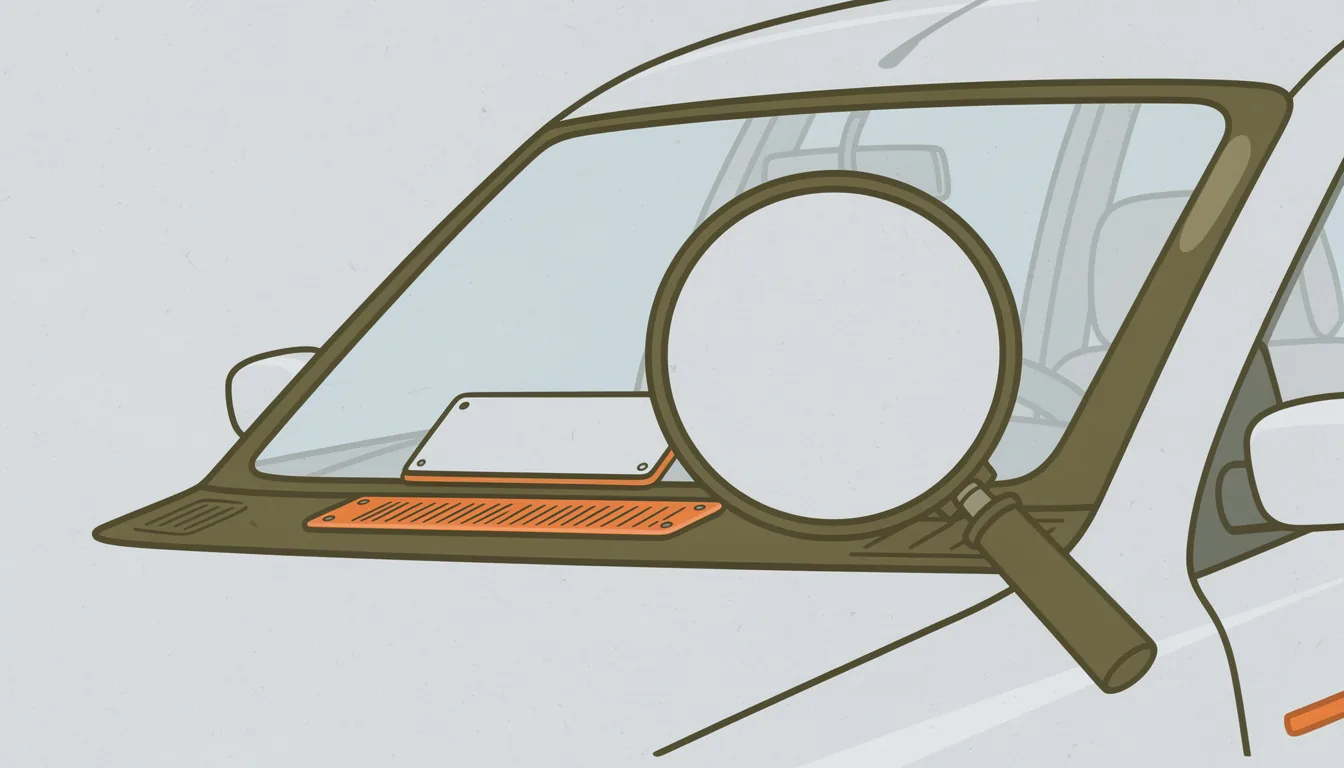
The VIN is a 17-character serial number. Stand outside the car on the driver's side and look down through the windshield where the glass meets the dashboard. There is a small metal plate there with the number stamped on it. Open the driver's door and you will find the same number printed on a sticker in the door jamb, usually alongside the tire pressure and build date. It is also on the title, the registration and the insurance card.
Read all four. The dash plate, the door sticker, the title and the registration should carry the same 17 characters, in the same order, every time. VINs never use the letters I, O or Q, because they look too much like 1 and 0 — so if you think you see one, look again. Photograph the plate and the sticker rather than copying by hand. One wrong character pulls a different car's history, and a clean report on the wrong vehicle is worse than no report at all.
A mismatch ends the viewing. Not a discount, not a phone call later — you leave. A dash plate that disagrees with the door jamb can mean the plate was swapped, that two wrecked cars were welded into one, or that the paperwork in the seller's hand belongs to a car parked somewhere else. Scratches around the rivets on the dash plate, a door sticker with peeling edges or a font that does not match the rest of the label are all reasons to walk. Honest sellers have clean, matching numbers and no story about why they do not.
What a VIN Actually Encodes
The 17 characters are not random. They split into three blocks, and knowing the layout helps you sanity-check a number before you spend money on it.
- Characters 1-3, the world manufacturer identifier. This says who built the car and where. The first character is the country or region of assembly, the next two narrow it to the maker and vehicle type.
- Characters 4-8, the vehicle descriptor. Model line, body style, engine, and restraint system. This block is what tells a decoder that a VIN is a four-door with a specific engine rather than a coupe.
- Character 9, the check digit. A number or the letter X, calculated from the other 16 characters using a fixed formula. It exists so a typed or altered VIN fails a math test rather than quietly pulling the wrong record.
- Character 10, the model year. A single letter or digit. The codes cycle, so the same character comes back around every 30 years — which is why the year alone never identifies a car.
- Character 11, the assembly plant.
- Characters 12-17, the serial number. The car's individual place in the production run.
You do not need to decode this by hand. What matters is that the structure exists, that a decoder can read it back, and that the specs it returns match the car in front of you. If the seller says it is the bigger engine and the decoder says otherwise, you have found something before you paid anything.
The Free Checks, and What They Miss
Run these first. They cost nothing, they take a few minutes together, and any one of them can end a bad deal before you spend a dollar. What follows is what each one actually covers and, more usefully, what it leaves out.
NHTSA VIN decoder and recall lookup
The National Highway Traffic Safety Administration runs two separate free tools, and people often confuse them.
The VIN decoder reads the number back as factory build data: make, model, model year, body class, engine, plant, and safety equipment fitted at build. Use it to confirm the car is what the listing claims. A 2016 advertised as a 2018, or a base trim sold as the higher one, shows up here in seconds.
The recall lookup is the one buyers care about more. Enter the VIN and it returns safety recalls that are still open on that specific car. Recall repairs are free at a franchised dealer regardless of how many owners the car has had, so an open recall is not automatically a reason to walk — but it is a reason to book the work in.
What it misses: the recall tool covers a limited recent window of model years, so an older car can come back clean simply because it is too old for the database. It shows manufacturer safety recalls, not voluntary service campaigns or technical service bulletins, and it says nothing about whether a fix was done badly. It also has no idea whether the car has ever been crashed, flooded, stolen or retitled. It is a build sheet and a recall list, nothing more.
NICB VINCheck
The National Insurance Crime Bureau offers a free lookup that flags two things: vehicles reported stolen and not recovered, and vehicles declared a total loss. Both come from insurance companies that are NICB members and choose to report.
It is genuinely useful and genuinely narrow. The service limits you to a small number of searches from one address in a 24-hour period — commonly five — so it is a tool for checking cars you are serious about, not for screening every listing you scroll past.
What it misses: only participating member insurers feed it. A car totaled by a small regional carrier, or one written off and quietly repaired without an insurance claim at all, can come back clean. It gives no owner count, no mileage readings, no accident detail, and no lien information. Treat a clear NICB result as "nothing showed up here", not as "this car is fine".
NMVTIS and its approved providers
The National Motor Vehicle Title Information System is run by the U.S. Department of Justice, and it is the closest thing to an official title record. States report title issuance and brands into it. Insurers and salvage yards report total-loss and junk vehicles. It is the database designed specifically to stop title washing, where a branded title from one state gets laundered into a clean-looking title in another.
You cannot query NMVTIS yourself. You buy a report through an approved provider, and the approved list is published on the government's own vehiclehistory.gov site. Reports from these providers are cheap — typically a few dollars for a single VIN — and for title brands specifically they are the most authoritative source you can buy.
What it misses: NMVTIS is a title and salvage system, not an accident or service system. It will show you that a title carries a salvage brand. It will not show you a fender bender that was paid for in cash, and it carries little or no maintenance history. Reporting speed also varies between states, so a very recent title change may not have landed yet.
State DMV title checks
Several states offer their own online title-status lookup, and a handful will confirm brands, lien status or registration standing for free or for a small fee. If the car has spent its life in one state, the DMV there is a good cross-check on what a report tells you.
What it misses: coverage is wildly inconsistent from state to state. Some offer nothing to the public. And a state can only tell you about the time the car spent registered there — the two years it spent under water in another state are invisible.
| Free source | What it shows | The main gap |
|---|---|---|
| NHTSA VIN decoder | Factory specs, build details | No history of any kind |
| NHTSA recall lookup | Open safety recalls | Limited model-year window; safety recalls only |
| NICB VINCheck | Theft and insurer total-loss records | Member insurers only; daily search limit |
| NMVTIS providers | Title brands, salvage and junk records | Thin on accidents and service history |
| State DMV lookup | Title and lien status in that state | Availability varies; one state only |
After the free checks, run a full vehicle history report on any car still worth viewing. It can surface the reported title, accident, odometer and lien records that the free tools split across separate databases.
What a Paid History Report Adds
Once the free checks are done, the questions that remain are the expensive ones. Who owned this car? How hard was it used? Did the mileage move the way it should? Does someone else still have a legal claim on it? Those answers sit behind a paid report.
A good vehicle history report pulls from a wider set of feeds than any single free tool, and stitches them into one timeline. Expect to see:
- Title records across every state the car has lived in, with any brand attached — salvage, rebuilt, junk, flood, lemon buyback.
- Reported accidents and damage, from police reports and insurance claims.
- Odometer readings captured over time, usually at title transfers, inspections and service visits.
- Ownership count and the length of each ownership, plus whether the car was registered to a person, a rental company, a lease or a commercial fleet.
- Service and maintenance records from shops and dealers that report into the system.
- Lien and loan records, showing whether a lender has a claim on the title.
- Theft and recovery records, and open recalls alongside them.
Here is the part most sites skip. No report is complete, and the reason is structural rather than a failing of any one provider. These systems only know what somebody chose to report. An independent shop that fixes a crumpled quarter panel for cash reports nothing to anyone. A driver who pays out of pocket to avoid a premium increase generates no insurance record. Some states report title events slowly, and some smaller insurers do not feed the databases at all.
So a clean report means "nothing was reported", not "nothing happened". That distinction is the whole reason the report is one step and not the entire job. Buy the report to catch the recorded disasters, then use your eyes and a mechanic to catch the unrecorded ones.
Reading the Report
A report is a list of facts. Turning it into a buy-or-walk decision means knowing which findings are fatal, which are negotiable, and which are noise.
Any title brand that is not "clean"
Salvage, rebuilt, junk, flood and lemon buyback are all brands, and each one permanently changes what the car is worth and how hard it will be to insure or resell. A rebuilt title is not automatically a scam — plenty of lightly damaged cars are repaired properly and retitled — but it must be priced accordingly and inspected far more carefully than a clean-title car. Read our guide to checking for a salvage title before you decide, and go through the flood damage car check if the car has ever been titled in a hurricane or flood state.
Odometer readings that go backwards or stall
Mileage should climb steadily across the timeline. A reading that drops between two entries is a rollback until proven otherwise. So is a car that somehow covered 4,000 miles in three years while changing hands twice. Our walkthrough on spotting an odometer rollback covers how to line the report up against the wear on the pedals, the steering wheel and the driver's seat bolster.
An open lien
If a lender is still listed on the title, the seller does not fully own the car. Paying a private seller cash for a car with an outstanding loan can leave you with no title and a repossession order. Learn how to check a car for liens and how to structure the payment so the loan gets cleared at the same moment the title transfers.
Gaps, moves and use type
A car that vanishes from the record for two years, or that hops between three states in a year, is worth asking about directly. Rental and fleet histories are not automatically bad — those cars often get serviced on schedule — but they are usually driven harder and should be priced lower.
Take any finding back to the seller and watch the response. A seller who says "yes, it was hit in 2022, here are the repair invoices" is telling you something useful. A seller who insists the report is wrong, without producing paperwork, is telling you something more useful still. When the report shows a problem you can live with at the right price, a full vehicle history report is also the document you hand back across the table when you open the negotiation.
Which Report to Buy
There is no single right answer, because the right report depends on how many cars you are checking and what you are most afraid of.
- Checking one car from a private seller. A single low-cost report is enough. Expect to pay a few dollars rather than the price of a tank of gas.
- Worried mainly about a washed or branded title. Buy from an NMVTIS-approved provider. That is the official title source, and it is the cheapest way to answer that specific question.
- Shopping hard and checking a dozen cars this month. A monthly subscription can work out cheaper per car, as long as you set a reminder and cancel it when you stop shopping.
- Buying from a dealer advertising a free report. Take theirs, then run a cheap second one yourself. Two databases catch more than one.
For the full rundown of low-cost options and what each one is actually good at, see our roundup of cheaper alternatives to Carfax. If you want a straight assessment of the budget service most readers here end up using — including the checkout billing trap worth knowing about — read the VINCheckUp review. And if you would rather see the options next to each other on price, data depth and billing model, our Bumper vs VINCheckUp vs Carfax comparison lays it out.
Whichever you choose, buy the report before you drive out to see the car, not after. It costs less than the gas.
A full vehicle history report on any car you are serious about
The VIN Check Is Not the Inspection
The report is paperwork. It tells you what has been written down about a car. It cannot hear a bearing whining, see the rust blooming under a rocker panel, smell the damp carpet, or feel the shudder when a transmission shifts into third.
Plenty of cars come back clean on paper and are still bad buys. A car repaired privately after a crash, a car with a tired engine that was never worth a claim, a car whose last owner skipped every oil change — none of that reaches a database. The physical check is where you find it. Work through the used car inspection checklist at the viewing, and if the car is still a contender after that, pay a mechanic for a pre-purchase inspection before you hand over money.
Both checks sit inside a bigger sequence: setting a budget, choosing where to buy, lining up finance, inspecting, negotiating and closing. Our guide to buying a used car puts them in order so you are not running the history check on a car you were never going to be able to insure.
Do the VIN check the day you find a listing you like. Do the walk-around the day you see the car. Do the mechanic's inspection before the deposit, never after.
Print the free inspection checklist PDF, put it on the passenger seat with the report printed beside it, and work down both lists in order at the viewing.
Quick answers
How do I run a VIN check for free?
Copy the 17-character VIN from the base of the windshield, then run it through two free federal tools. The NHTSA VIN decoder returns the factory build details, and the NHTSA recall lookup shows open safety recalls. The NICB VINCheck flags vehicles reported stolen or written off as a total loss by member insurers. Both take about a minute. Neither one shows accidents, owner count or mileage history.
What does a VIN check show?
A free check shows factory specs, open safety recalls, and theft or total-loss records reported by insurers who take part. A paid history report adds the title record with any brands on it, reported accidents, odometer readings taken over the years, how many people have owned the car, whether it was a rental or fleet vehicle, and whether a lender still holds a lien.
Is a free VIN check enough before I buy a car?
Not on its own. The free federal tools are narrow by design. They will not tell you the car changed hands five times in three years, that its mileage dropped between two title transfers, or that a credit union still holds the title. Run the free checks first because they cost nothing and can end a bad deal early, then buy a report on any car you are serious about.
Where is the VIN on a car?
Look through the windshield from outside, at the driver's-side corner where the glass meets the dashboard. There is a second copy on a sticker inside the driver's door jamb, visible with the door open. The same number appears on the title, the registration and the insurance card. Older vehicles may also carry it on the engine block or the firewall.
What if the VIN on the car does not match the paperwork?
Stop the viewing. A VIN on the dash that differs from the door-jamb sticker or the title is not a clerical slip you should work around. It can mean the plate was swapped, the car was rebuilt from two vehicles, or the title belongs to a different car entirely. Do not pay a deposit, and do not accept a promise to sort it out later.